
For this Video Game Exploration, my learning circle and I decided to research a variety of websites. We wanted to find a site or an app that fit the appropriate criteria matter when considering learning games. To go about this, we thought we should choose a specific subject so that we could narrow our search. However, we quickly realized, by doing this, we were missing out on a range of learning games that could be beneficial to children’s learning and development. We wanted to learn about as many quality games as we could so that we would be better prepared to incorporate learning and video games into our curriculum as future teachers. Sites like Education.com, BrainPOP Jr., and PBS Kids were extremely useful because they provided us with a plethora of subject areas. After exploring these different educational sites, we landed on PBS Kids, which offered twenty-nine topics, as seen in the following picture.
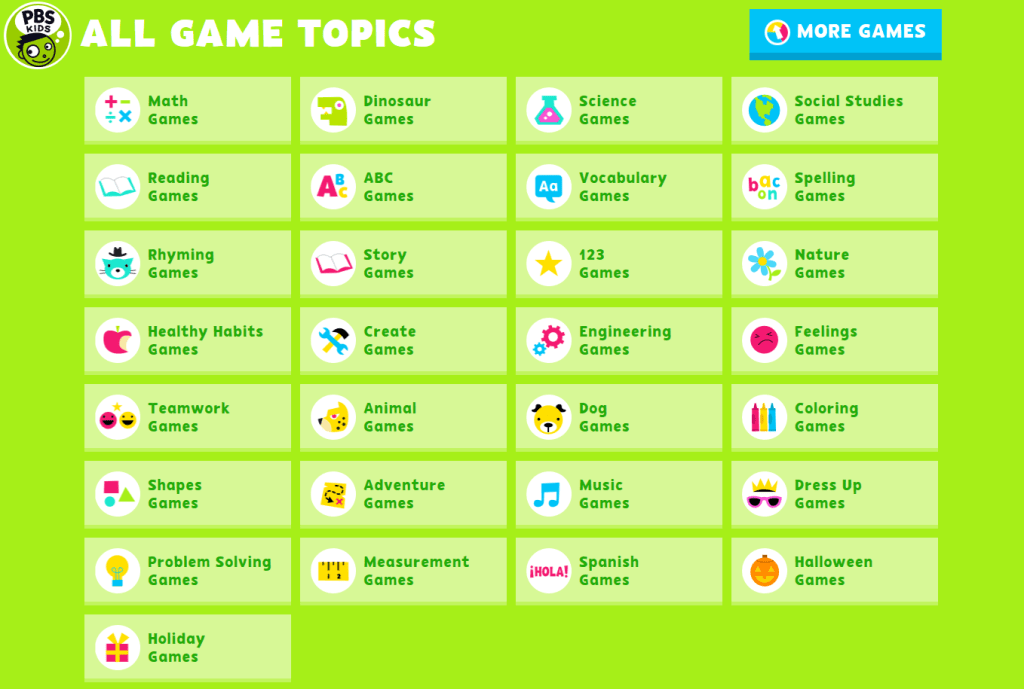
We looked through the various topics and played several of the games that highlighted these content areas. Our learning circle discovered that quite a few of the games that related to the traditional subject areas were either repetitive, drill and practice games, not challenging enough, or not engaging enough. For this reason, we decided to expand our search and began looking at other topics including engineering games. There, we found the game titled “Hamster Run,” which references the “The Ruff Ruffman Show.” Once the player selects this game, they are directed to a title page where they are to click the arrow to begin. The main character, a dog named Ruff Ruffman, describes the purpose of the game. That is, the hamsters cannot reach their carrots, so the players have to help build a way for the hamsters to get their food. The player has the option to listen or to skip this intro, but either way, they end up on a screen that has them select “Play” or “Create.” However, to press “Create,” and then build their own challenges, they have to play and unlock different levels first. When they press play, the player is taken to the list of challenges, which are shown in the picture below. I appreciate how students have to unlock the different levels as they play and improve their skills.

Once they select their level, they can also choose which hamster they want to play with it. The more they play, the more hamsters the players get to choose from. As I am navigating through the game, I am discovering more and more ways children can continuously change their game so that they stay interested and challenged. This can even be seen throughout the game itself. Moreover, Ruff Ruffman explains how the player has to help the hamster get the carrot by tapping and dragging the blocks onto the board or dragging them off to remove them. As you can see from the picture below, the square is the only block highlighted, which means it is the only shape the player can use to reach the carrot. The other shapes and lines will become available as the player successfully completes more challenges. Meaning, the game itself is continuously changing and getting harder as the player becomes more familiar and better at problem-solving.
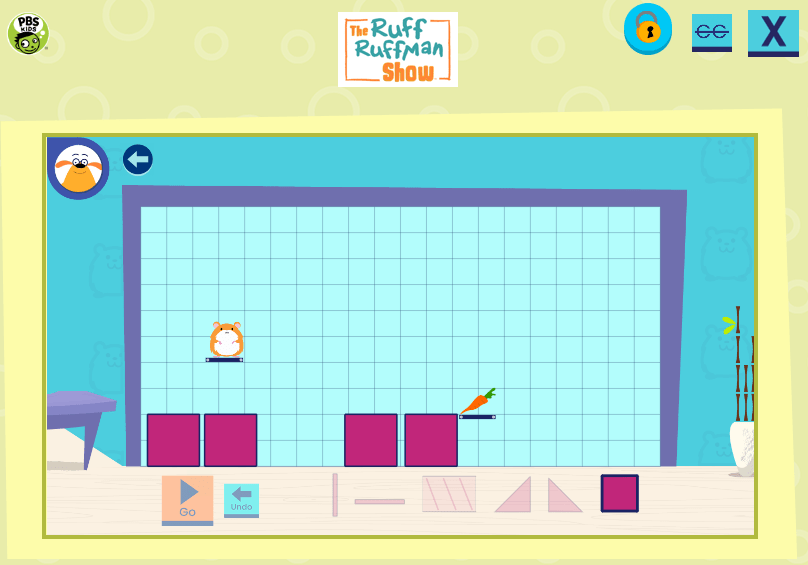
As soon as the player believes they have used their problem-solving skills correctly, they can press “Go,” and the hamster will run to their carrot. If their path does not work, they can press “Undo” and try again until the hamster successfully makes it across to their carrot, as shown here.
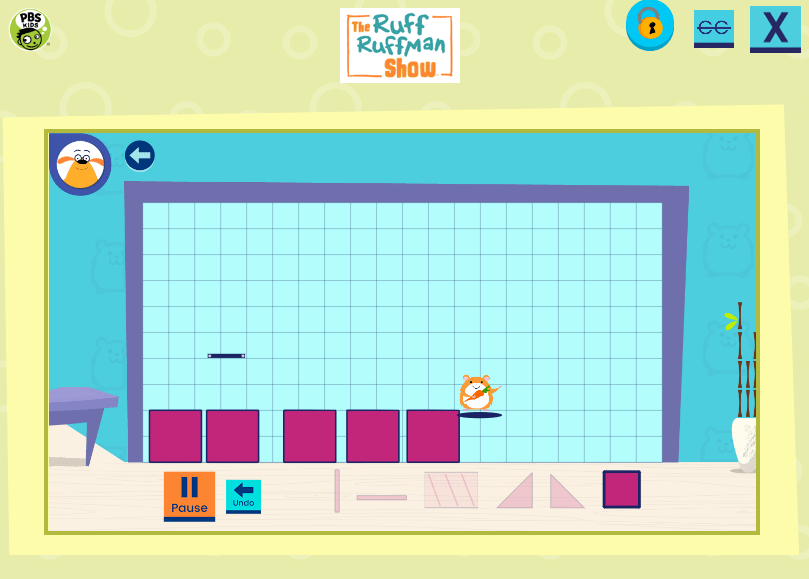
After the hamster has reached the carrot, the player then unlocks the next challenge and has access to a new level. These different levels are what immediately drew me to this game.
Often times, games become so repetitive that children either become bored, uninterested, or unengaged. The purpose of the game is no longer met because the child is not active in their learning. This game, however, allows children the chance to be entertained, engaged, and educated. I know, as I was learning to play the game, I was quickly drawn in by the characters and the choices I was given. Ruff Ruffman clearly stated the directions and provided me with step by step directions, so that I could understand what I needed to do. That way, I was able to focus solely on the purpose of the game, my decision-making, and my problem-solving skills, rather than trying to figure out how to play the game.
 Abigail's Blog
Abigail, I really enjoyed how in depth you went throughout your blog post 1. As I read through your blog, I was curious as to if Ruff Ruffman provides information when new shapes or lines are unlocked. I feel as if it would benefit children to understand which shapes they are using and the names of them. For example, as they choose to use the square in the path, Ruff Ruffman would say the word “square.” This will help learners who enjoy listening while also benefiting from hands on learning. I really enjoyed how you incorporated the aspect of the “undo” button. I did not put that in my blog post. This provides an outlet for students who make multiple mistakes and want to change their decisions they make during that specific level they are working on. In the Squire reading we discussed in class, it specifically states that “they give students the experience of being competent, independently thinking problem solvers, enabling them to develop identities in relation to an established community of practice” (Squire 8). This game does give the students the experience of working independently while solving a problem. Great work on your blog! I believe if someone who did not know how to play this game would understand how to after reading your blog!
LikeLike
Abbie,
I really liked how you addressed all the topics that PBS offers to use in the classroom. This is a great resource to focus on a certain thing. This is helpful for a teacher to narrow down their search when it comes to finding a game that will work in their classroom. I think you made a great point about how when you play the game you were continually discovering more and more ways children can continuously change their game so that they stay interested and challenged. This is an important aspect that we not only addressed in class but also in the readings about how to chose a video game that would be appreciate to use in the classroom.
LikeLike