
As I continued playing “Hamster Run,” I began to look at the video game from a different perspective. When I first selected the game and began playing it, I pretended as if I was the child familiarizing myself with it. I was focused on learning how to play it just as a child would. I then shifted my mindset to that of a teacher and tried playing the game. This time, I focused on the learning behind the game. I noticed that the purpose of the game was different for both the child and the teacher. Moreover, when a child plays this game, the purpose of it is solely to get the hamster to its carrot. Whereas, a teacher views the purpose of this game is to practice and develop problem-solving skills. These skills and the curriculum behind the video or computer games are what teachers pay more attention to, and rightfully so. They are integrating the game into their curriculum so that the learning and teacher experience is enhanced. Yet, for students to sufficiently improve their learning, the game has to be both engaging and educational. In the Mindshift Guide to Digital Games + Learning chapters, it states that “the best learning games are always fun” (Shapiro 20). To ensure that “Hamster Run” was both engaging and academically stimulating, I played it through the eyes of the teacher and the student.
Ultimately, the goal of the game is to build structures to help our hamsters reach their food. But, to do this, students have to use the engineering design process to build, test, and redesign their structures. They are using and enhancing their science, math, engineering, technology, and problem-solving skills. This aligns with the Mindshift Guide to Digital Games + Learning article. In this text, it states that “long-form games tend to foster skills like ‘critical thinking, problem solving, collaboration, creativity, and communication’” (23). “Hamster Run” is a perfect example of a long-form game because it “start[s] simply and expand[s] over time, so [it] can easily form the backbone of an entire curriculum (23). The two pictures below show the first six levels and then the last six levels of the game. By looking at the individual panes, one can see how the difficulty of the game increases dramatically. However, it starts simple and expands as the student fosters and further develops their skills.


Problem solving and technology are areas that are vital for students to broaden their knowledge in. For this reason, the game, “Hamster Run” is beneficial for children of any age. But, I, personally, would recommend implementing this game in any kindergarten through fifth-grade classroom. This is because there are specific standards that could be assessed while students play the game. More specifically, for kindergarten through second grade, I would assess the design and technology standards. Within this set of standards, students are able to identify a problem and use an engineering design process to solve the problem. Standard K-2. DT.2.b, specifically, states students can demonstrate the ability to follow a simple design process: identify a problem, think about ways to solve the problem, develop possible solutions, and share and evaluate solutions with others. This is an ideal standard for the game, “Hamster Run,” because there is a problem and the players have to develop a solution to solve it. The problem being the hamster cannot reach his food, and the solution is a path to the carrot. The players have to develop these solutions by using the lines and shapes that are available. And, there are several possible solutions and paths, the player can make. These two pictures are taken of the same level, but with two different, yet both successful, pathways.

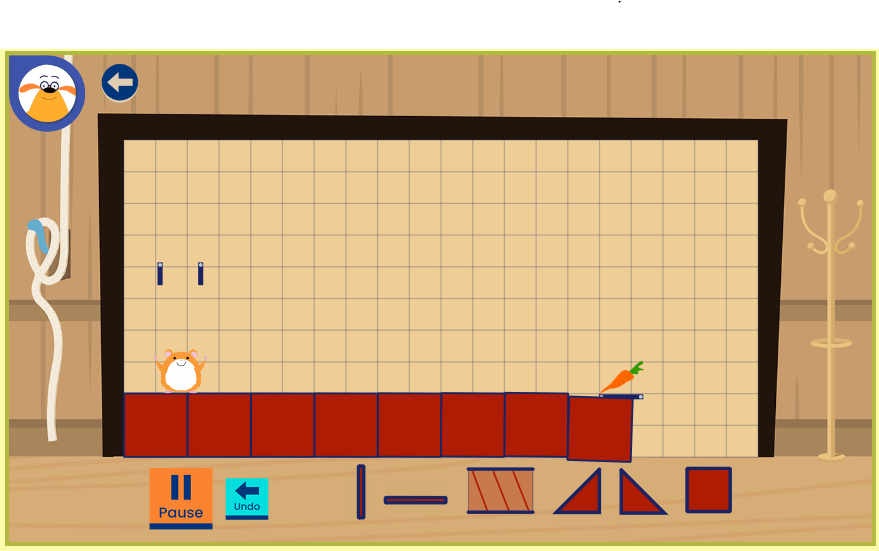
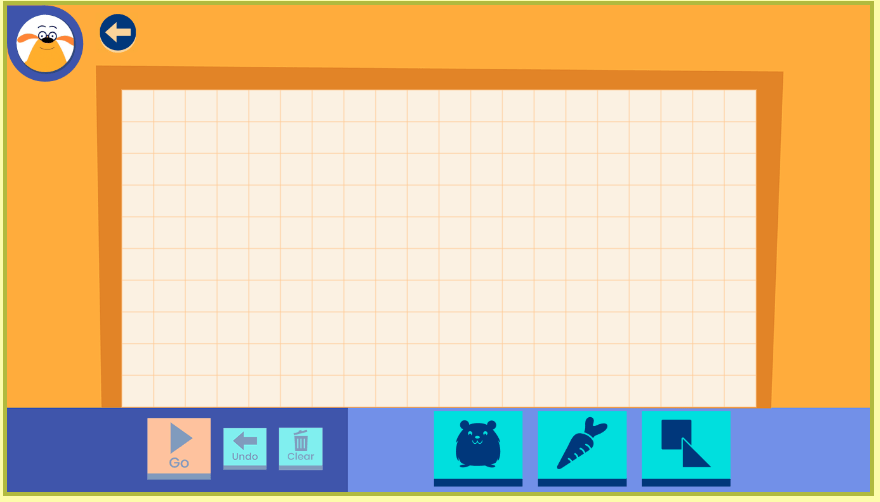
The younger children playing this game, are just starting to learn their shapes and how-to problem solve, so this game allows them to recognize and use the shapes at an introductory level. Whereas the older students are more familiar with shapes and problem-solving, so the first few levels of this game may serve more as practice. After the first few levels, the levels will begin to get harder and more challenging for the students. They will even be able to create and design their own challenges. Here, the game can be applied to standard 3-5. DT. 2.b: Plan and implement a design process: identify a problem, think about ways to solve the problem, develop possible solutions, test and evaluate solution(s), present a possible solution, and redesign to improve the solution. The standard is very similar just with slight degrees of difficulty. Comparably, the game is the same for every grade, but the difficulty changes as the students improve their skills and are able to complete higher levels or even create their own. When the older students select “Create,” they have the opportunity to build their own challenges to see if the hamster can get their carrot. The picture below shows what the screen looks like when the student chooses “Create.” Not only does the player get to create a pathway, but they also get to create the problem by choosing where they want to place the hamster and carrot.
Below is an example of a path, I successfully created.
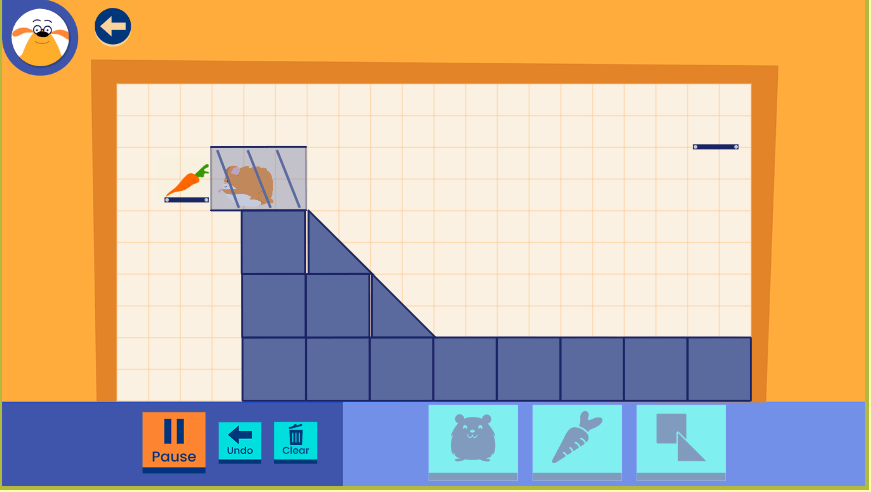
As I was creating my path, I was testing and developing different problems and solutions and redesigning to improve the solution. I was doing exactly what the above standard assesses.
The more I played and the more I created, the more I realized how this game was entertaining, engaging, and educational. Since starting this Video Game Exploration, I agree even more with Shapiro, saying, “The best learning games are always fun” (26). This is because, the game, “Hamster Run,” is a prime example of it.
 Abigail's Blog
Abbie,
I like how you first went through the game playing as a student then moved into playing as a teacher because I can see how changing views would allow you to learn from both sides.When I was choosing my standards, I also realized that students may simply see the point of this game as to find a carrot, but the standards allowed me to find more in depth approaches to the game that students should be taking. With that being said, if I used this game in my classroom, I would want to share the standards with my students ahead of time so they know that there is more to the game than just reaching the carrot. I noticed that you aligned your standards with grades 3-5 and I did too. I thought that was interesting because even though younger students are able to play, they may become frustrated easily when they start to reach the more difficult levels and they may just give up at that point instead of realizing that it is supposed to be challenging. Overall, I really enjoyed your post and agreed with a lot of the points that you made.
LikeLike