
As an Early Childhood Education major, I wanted to focus on a grade-appropriate technology integration lesson. For this reason, I read through the list of distributed cognition video learning experiences, watched a few that took place in an elementary classroom, and decided on Differentiating Instruction Through Interactive Games. This short video follows one of Mr. Robert Pronovost’s second-grade math lessons. Using technology tools and games acquired through grants and his own resourcefulness, he was able to teach and tailor his math instruction to his students and their individual learning styles. A variety of technologies were integrated into the classroom to help students learn and enhance their understanding of the curriculum. The Distributed Cognition Theory provides opportunities for this academic growth and development. According to the Michael Morgan, Gwyn Brickell, and Barry Harper’s piece, “distributed cognition is a way to understand how people interact with their environment and how they can be enabled by the environment to undertake highly complex tasks that would usually be beyond the abilities of the unassisted individual.” (Morgan et al. 127). This means that students can improve their human cognition by using internal and physical resources and tools.
Mr. Pronovost uses several of these tools in order for learners to conduct activities and complete lessons in technology-mediated learning environments. He is intentional in how he integrated technology so that he could promote appropriate learning outcomes. Intentional teachers are educators who have a purpose for their decisions. For Mr. Pronovost, he decided to use technology in his lesson because it allows for differentiated instruction. Technology provides immediate feedback, gives students the opportunity to work at their own pace, and supports students who may need it. In this specific lesson, Mr. Pronovost integrates technology throughout his addition and subtraction lesson for these reasons.
He begins and ends his lesson in a whole group setting on the classroom carpet. The students are introduced to the topic, practice identifying clue words, and identify when they need to add or subtract in word problems. Once he feels the students have a decent understanding, he moves them to technological tools. The students work on whiteboards to solve problems, and then they shift over to their computers. This is an example of translation, which “refers to the transformation of information from one representation system to another” (Martin 93). Students are still working on addition and subtraction, but by using a different tool, the information is translated. The computer is used for students to engage in independent practice. So, instead of working in a group on word problems, students work on expression problems independently. They complete three rounds of the game, Planet Turtle, and have to get at least 80 percent correct before they can move on to DreamBox or the iPod, which serves as a more extensive transformation of information.
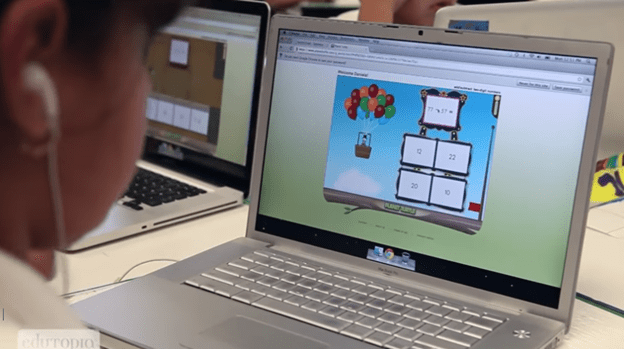
This is because Planet Turtles serves as basic practice for the entire class at the same level. Once they show mastery with these math games and questions, they can move to DreamBox, which is individualized practice and instruction. Meaning, it ensures meaningful communication by giving instruction and content that is translated into something that is academically appropriate for each student.
Both of these technological resources are examples of the effects of and effects through technology and off-loading. Effects-of technology help develop cognitive ability, knowledge, and a deeper conceptual understanding. Effects-through technology not only enhances cognition of thinking but ultimately reorganizes. These online resources allow students to practice the concepts they have already learned. A smarter performance would lead to a deeper and more thorough understanding. It also provides students with the scaffolding they need to succeed in the classroom. This is because technology, specifically online games, that have levels and provides feedback that gives the teacher the opportunity to support the students who need it most. Moreover, the teacher is able to walk around and provide additional instruction, answer any questions, and address any concerns with the students who are struggling with addition and subtraction. This help can provide students with just the right amount of support that they need to succeed. This is known as scaffolding. Additionally, DreamBox helps students succeed by individualizing their instruction to differentiate each child’s learning styles and needs. Students are succeeding at a much higher rate because the technology is differentiating.
Another example of differentiation is the use of off-loading. Off-loading refers to subtasks that are used to help achieve a learning goal These subtasks are not necessarily specific to the content being taught and can be used throughout several different lesson topics. Examples of off-loading include, “the use of a written list to aid in remembering a series of items, the use of calculators to do arithmetic during mathematical problem solving, or the use of an autocorrect functioning a word processor while composing text” (Martin 94). In Mr. Pronovost’s lesson, students can use their fingers or whiteboards as tools to help them succeed. Whiteboards and dry erase markers are also a tool and form of technology used in the whole group setting.

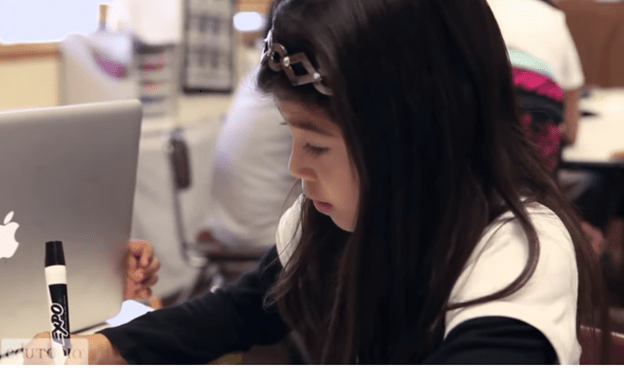
In fact, students are encouraged to use all the tools that are available to them. Mr. Pronovost states, “the computer is not always the best tool.” Sometimes these off-loading examples are the best strategies for students to use. In the end, Mr. Pronovost asks and encourages his students to use the tools and strategies that will strengthen their human cognition.
These games are designed to determine human cognition growth, monitor progress, and are constantly assessing students’ masteries of concepts. The children think they are just playing to make it to the next level, but these levels are actually letting the teacher know if the child has grasped that specific idea before moving on to a more difficult topic or type of problem. This serves as a form of feedback to the teacher. Feedback is also given to the students who are playing the games and are engaged in online learning. As described in the Martin article, monitoring “can occur through observation of behaviors, or more actively, through assessment techniques such as asking questions or assigning problems to solve” (Martin 94). Planet Turtle and DreamBox perform monitoring by assigning problems to solve that assess students’ understanding in addition to giving them feedback relating to their understanding. This immediate feedback would not have been given if Mr. Pronovost had not incorporated technologies like these in his classroom. Additionally, without technology, students would likely get bored and not feel challenged. This integration of technology engages and excites students.
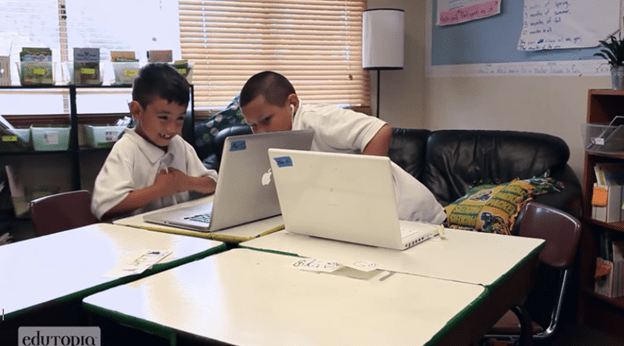
In the end, students who are engaged and excited, are more likely to learn and are thus more likely to become smarter. My observations support this idea and lead me to believe that technology does provide the opportunity to act smarter. The technologies in the classroom help improve students’ performances, which can eventually help students learn and develop more.

The students use technologies to enhance their learning, which will help them become smarter. However, this begins with the students themselves using and applying the appropriate tools to their concept understanding. Salomon’s article suggests that cognitive technologies are “technologies that afford substantial support of complex cognitive processing – make people smarter in the sense of enabling them to perform smarter” (Salomon 76). This suggests that with the right tools students can further enhance their learning and development, which is the main idea of distributed cognition. Meaning, that cognition is distributed between and among students, and the technologies used to augment the classroom practices and the students’ performances.
 Abigail's Blog